
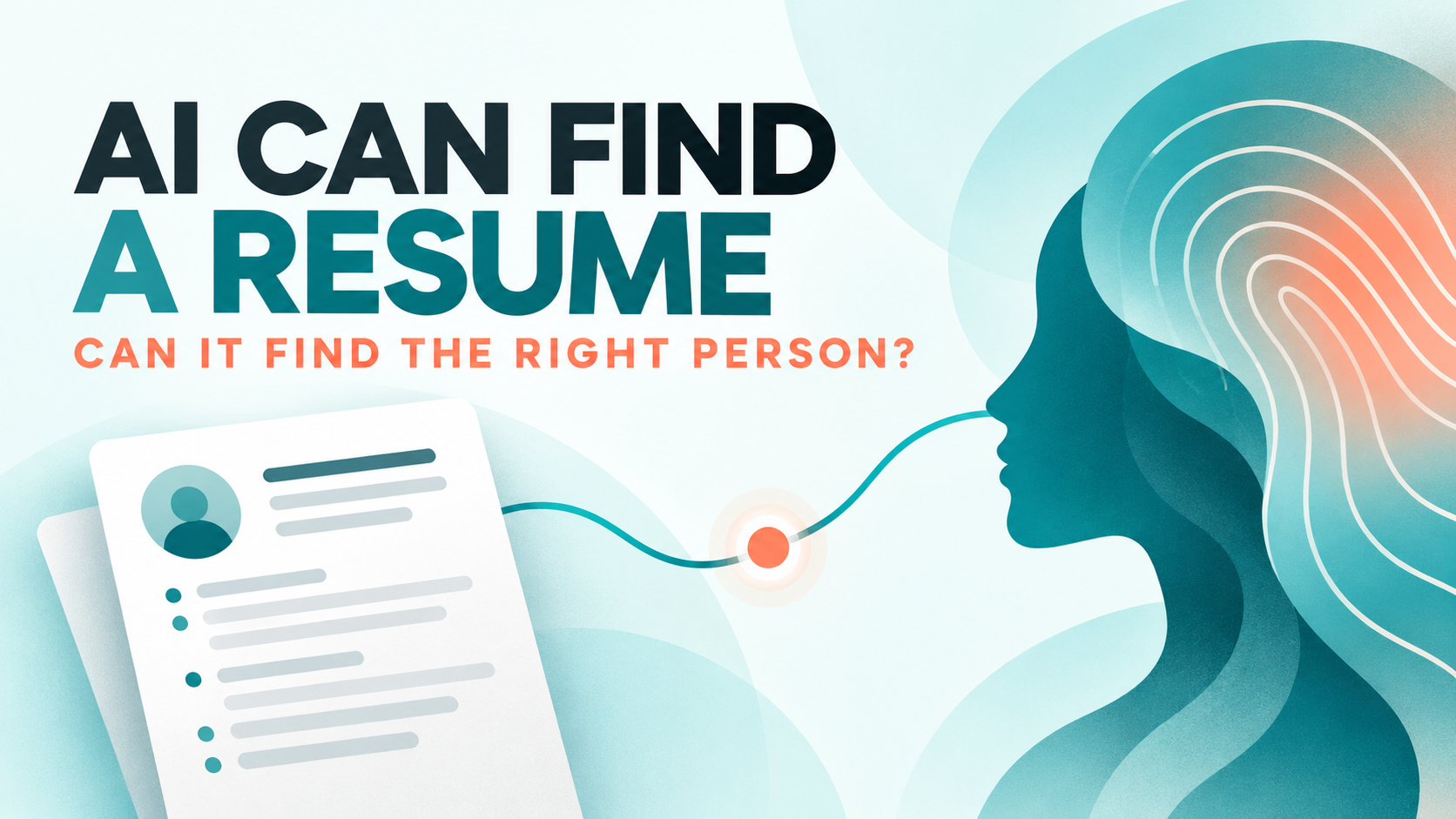
AI in recruitment is changing quickly. It can search thousands of profiles, identify patterns, match keywords and surface candidates faster than ever before.
And I think that’s a good thing.
But after more than 25 years in recruitment, I’ve learned that finding someone’s resume and understanding whether they’re the right person are two very different things.
A resume can tell you where someone worked, what they did and how long they did it. It can’t always tell you why they made the choices they made, what motivates them, how they lead, what kind of environment brings out their best, or what they’re capable of becoming.
That’s where the conversation begins.
The Resume Is Only Part of the Story
Two people can have remarkably similar resumes and be very different candidates.
One may have spent years building a career in a particular industry because they loved the work. Another may have followed opportunities that made sense at the time, but is now looking for something completely different. One may thrive in a highly structured organization. Another may do their best work in an entrepreneurial environment where they can build, change and lead.
Those differences rarely appear in a keyword search.
When I speak with a candidate, I want to understand the story behind their experience, not just their career history. I want to understand the journey that brought them here. Why did they make certain decisions? What are they proud of? What challenges have they faced and how did they respond? What have those experiences taught them about themselves? I want to understand what motivates them, what kind of environment brings out their best, how they lead, how they respond when things are difficult, and what matters to them outside of a job title. And I want to know what they are looking for next and, perhaps most importantly, why.
Those conversations often reveal things a resume never could.
AI in Recruitment Is a Tool. Judgment Is the Difference.
AI has an important role to play in recruitment. Used well, it can help us research markets, identify potential candidates and work through information far more efficiently than we could before. Recent research from LinkedIn reinforces this shift. As AI becomes more embedded in hiring, the conversation is moving beyond speed and efficiency toward something more important: the quality of who gets hired.
But efficiency and judgment are not the same thing.
An algorithm can identify someone whose experience appears to match a role. It doesn’t necessarily know that the candidate is ready for a bigger challenge, that they have been quietly leading well beyond their title, or that the culture they are leaving is exactly what your organization is trying to change.
It can also miss the person whose career path isn’t perfectly linear, whose title doesn’t quite match the search criteria, or whose most valuable qualities aren’t easily captured in a database.
That’s why I see technology as something that should make a recruiter better, not replace the parts of recruitment that require curiosity, conversation and judgment. That philosophy is also reflected in how we approach every search, beginning with understanding the organization, the role and the story behind the person we’re looking for.
The technology can help us find people. Our job is to understand them.
The Right Person Is More Than a Match
The goal of recruitment shouldn’t be to find the person who looks most like the job description on paper. It should be to find the person who can succeed in the role, contribute to the organization and thrive in its culture.
That requires understanding both sides of the search.
Before I begin looking for candidates, I spend time learning the client’s story. Where is the organization going? What is happening within the team? Why does this role exist? What kind of person succeeds there? What hasn’t worked before? And what does the organization really need from this hire?
Only then can I properly listen to a candidate’s story.
Experience and capability matter enormously. But so do motivation, leadership style, personality, ambition and culture. Sometimes the candidate who looks perfect on paper isn’t the right person. And sometimes an exceptional candidate becomes obvious only after you understand the story behind their resume.
That’s the part of recruitment I don’t believe should ever be automated.
AI in Recruitment Will Keep Changing. People Will Still Matter.
Recruitment will continue to evolve, and I think it should. Better technology gives us better tools to research, connect and work more efficiently.
But the best hiring decisions have never been about finding the greatest number of candidates. They’re about understanding what an organization truly needs and recognizing the person who can make a meaningful difference there.
That takes more than data.
It takes listening. It takes curiosity. It takes experience. And sometimes it means seeing something in a person that isn’t immediately obvious on their resume.
Everyone has a story. The right hire starts with understanding it.
Learn more about how Lead Search Group approaches recruitment and executive search.